


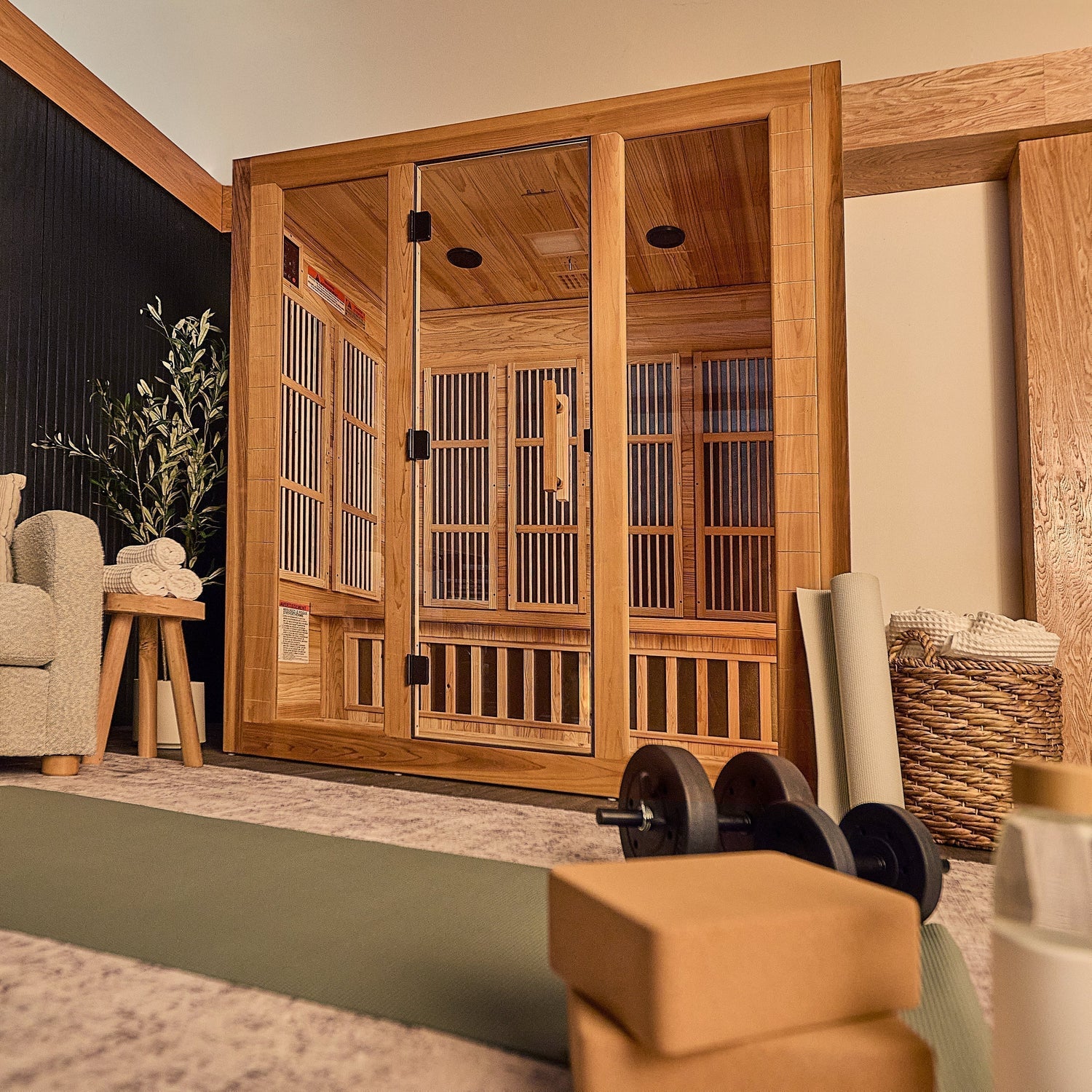
If you train seriously, you've probably looked into using a sauna for sore muscles or heard someone mention it as a recovery tool. Maybe it was a podcast clip about heat shock proteins. Maybe a training partner swears by a post-workout session. The question you're actually asking is straightforward: does it work, how does it work, and what should a practical protocol actually look like?
This guide shows you what published research says.
Does a Sauna Help with Muscle Recovery?
Yes. Post-exercise sauna use supports muscle recovery through increased blood flow to damaged tissue, activation of heat shock proteins that help repair damaged muscle proteins, and reduction in inflammation markers. Published studies in competitive runners and team sport athletes show measurable improvements in neuromuscular recovery and reduced soreness following regular post-training sauna sessions.
How Saunas Support Post-Workout Muscle Recovery
When your body is exposed to sustained heat — whether from a traditional sauna at 150–194°F (65–90°C) or an infrared sauna at 120–150°F (49–65°C) — it triggers a cascade of physiological responses that overlap meaningfully with recovery processes.
Increased blood flow. Heat causes vasodilation, widening your blood vessels and increasing circulation to muscles, connective tissue, and skin. After training, this enhanced blood flow delivers oxygen and nutrients to damaged muscle fibers more efficiently while helping clear metabolic waste products like lactate. This is the same reason light active recovery (walking, easy cycling) helps with soreness. A sauna achieves a similar circulatory effect without any additional mechanical stress on tissues that are already fatigued.
Heat shock protein activation. When core body temperature rises, cells produce a family of proteins called heat shock proteins (HSPs), particularly HSP70. These proteins function as molecular chaperones: they help repair misfolded or damaged proteins within cells, protect cells from stress-related damage, and play a role in reducing inflammation. For athletes, this matters because exercise itself damages muscle proteins. The heat shock response essentially accelerates the repair process that's already underway after training.
Reduced inflammation markers. Multiple studies have documented that regular heat exposure is associated with reduced levels of C-reactive protein (CRP) and other systemic inflammation markers. For recovery purposes, this means the inflammatory response that causes post-training soreness and stiffness may resolve more quickly with consistent sauna use.
Nervous system regulation. Training, especially high-intensity or high-volume sessions, shifts your autonomic nervous system toward sympathetic dominance (the "fight or flight" state). A sauna session initially increases sympathetic activity as your heart rate rises in response to heat, but the post-sauna cool-down period appears to promote a parasympathetic shift — toward the "rest and digest" state that facilitates recovery. This is consistent with research on autonomic function after heat exposure, and it's part of why many athletes report sleeping better on days they use a sauna after training.

Sauna for Athletes: What the Research Shows on Performance and Recovery
The research on sauna and athletic performance falls into two categories: endurance and strength/power recovery. Here's what the most relevant published studies found.
Sauna and Endurance Performance
A 2007 study by Scoon et al. in the Journal of Science and Medicine in Sport tested six competitive male runners through a three-week protocol of post-training sauna sessions (approximately 30 minutes at 194°F / 90°C after each run, about 12 sessions total). The results were notable: run time to exhaustion at 5K race pace increased by 32%, which translated to an estimated 1.9% improvement in time-trial performance. The primary mechanism appeared to be blood volume expansion, with plasma volume increasing by 7.1%, meaning more oxygen-carrying capacity per heartbeat. It's worth noting the small sample size here. The magnitude of the effect is striking, but should be interpreted alongside the larger Kirby et al. cohort below, which confirmed performance gains at a more modest but still meaningful scale.
A follow-up study by Kirby et al. (2021), published in the European Journal of Applied Physiology, expanded on these findings with a larger, mixed-sex cohort of 20 middle-distance runners. Three weeks of intermittent post-exercise sauna bathing (about 30 minutes, three times per week) improved VO2max by approximately 6% and running speed at lactate threshold by roughly 4% compared to the control group. The study also confirmed thermoregulatory adaptations that would benefit performance in hot conditions.
Infrared Sauna for Strength and Neuromuscular Recovery
Mero et al. (2015), published in SpringerPlus, compared far-infrared sauna at 95–122°F (35–50°C) to traditional Finnish sauna and no-sauna conditions in ten physically active men following both strength training and endurance sessions. After endurance training, countermovement jump height recovered more quickly in the far-infrared group compared to the no-sauna group. The study also noted that far-infrared sauna produced less cardiovascular strain than traditional sauna (heart rate was significantly lower post-session), making it a potentially better fit for athletes who want recovery without additional cardiac stress.
A more recent study by Ahokas et al. (2023), published in Biology of Sport, tested 16 male basketball players through a randomized crossover design. After a resistance training protocol (maximal strength combined with plyometrics), participants either sat in an infrared sauna at 109°F (43°C) for 20 minutes or did passive recovery at room temperature. The infrared sauna group showed significantly better recovery of countermovement jump performance and reported less muscle soreness 14 hours after exercise compared to the passive recovery group.
Study Summary
| Study | Year | Subjects | Protocol | Key Finding |
|---|---|---|---|---|
| Scoon et al. | 2007 | 6 male runners | ~30 min at 194°F (90°C) post-run, 3 weeks | 32% increase in time to exhaustion; 7.1% plasma volume expansion |
| Kirby et al. | 2021 | 20 middle-distance runners | ~30 min, 3x/week post-exercise, 3 weeks | ~6% VO2max improvement; ~4% lactate threshold speed gain |
| Mero et al. | 2015 | 10 active men | Far-IR at 95–122°F (35–50°C) post-training | Faster jump recovery with far-IR; lower cardiac strain vs traditional |
| Ahokas et al. | 2023 | 16 male basketball players | IR at 109°F (43°C) for 20 min post-resistance training | Better jump recovery and less soreness at 14 hours |
| Vanin et al. | 2018 | Meta-analysis (multiple RCTs) | PBM (red light) around exercise | Improved muscular performance and reduced fatigue |
| Ferraresi et al. | 2016 | Review (multiple studies) | PBM protocols | Reduced CK, oxidative stress, and DOMS |
Infrared vs. Traditional Sauna for Muscle Recovery
Both types work for recovery, but through slightly different mechanisms, and the practical differences matter for how you'd use each one.
Traditional outdoor saunas produce a stronger cardiovascular stimulus: higher heart rates, greater sweat volume, more intense heat shock protein activation. The Finnish cohort studies on long-term cardiovascular health (Laukkanen et al., 2015 in JAMA Internal Medicine, a 20-year study of 2,327 men showing 40% reduced all-cause mortality in frequent sauna users) were conducted exclusively with traditional saunas. If cardiovascular conditioning, heat acclimation for endurance sports, or the broader traditional sauna benefits supported by long-term population data are your primary goals, that's the stronger evidence base.
Infrared saunas for home recovery operate at lower air temperatures but heat the body through radiant energy absorbed at the skin surface, producing a deep, sustained warmth that differs from the convective heat of a traditional sauna. The Mero and Ahokas studies cited above both used infrared saunas and found measurable recovery benefits with less cardiovascular strain. For athletes who train twice a day, who are deep in a heavy training block, or who want recovery without the additional cardiac load of a 194°F (90°C) session, infrared may be a better fit. How many heating panels surround you and where they're positioned determines whether that radiant heat reaches your full body or just warms whatever's closest to a single panel.
The honest answer: either one works for post-exercise recovery. Your choice depends on your training context, your heat tolerance, and whether you value the broader cardiovascular benefits of a traditional sauna or the lower-stress warmth of infrared.
Red Light Therapy and Muscle Recovery: What Photobiomodulation Adds
Red light therapy, formally known as photobiomodulation (PBM), has its own body of evidence for muscle recovery, and it works through mechanisms that are distinct from but complementary to heat exposure.
PBM uses specific wavelengths of light (primarily red at ~660nm and near-infrared at ~850nm) to interact with mitochondria in muscle cells. The light energy is absorbed by cytochrome c oxidase, a key enzyme in the mitochondrial electron transport chain, which increases ATP production and improves cellular energy metabolism. In simpler terms, your muscle cells get more fuel for the repair work they're already doing after training.
A 2018 systematic review and meta-analysis by Vanin et al. in Lasers in Medical Science examined the cumulative evidence across multiple randomized controlled trials and found that photobiomodulation applied around exercise improved muscular performance and reduced fatigue in healthy subjects. Ferraresi et al. (2016), in a comprehensive review published in the Journal of Biophotonics, documented that PBM enhances muscle recovery by reducing creatine kinase (a marker of muscle damage), lowering oxidative stress, and decreasing delayed-onset muscle soreness.
What makes this relevant to sauna recovery is the potential interaction between heat and light. During a sauna session, your blood vessels are already dilated and tissue perfusion is elevated. The hypothesis is that warmed, well-perfused tissue may absorb light energy more readily, which is why combining red light therapy with infrared heat in the same session is a logical pairing. That said, the combined heat-plus-light protocol hasn't been studied head-to-head against PBM alone, so this remains a plausible inference rather than an established finding.
Backyard Discovery's infrared saunas include a ceiling-mounted red light therapy panel that delivers both 660nm and 850nm wavelengths, so you're layering photobiomodulation with infrared heat in the same session rather than buying a separate device and building a second protocol around it. For recovery-focused athletes, that means one session is doing double duty.
Sauna After Workout: A Practical Recovery Protocol
Based on the protocols used in the published research, here's a practical framework you can adapt to your own training.

Timing: Within 30 minutes of finishing your training session, based on the timing used in the published protocols. Every study showing recovery benefits used post-exercise sauna, not sauna on separate days. The combination of exercise-induced and heat-induced stress appears to amplify the adaptive response.
Temperature: For traditional sauna, 187–194°F (86–90°C), which is the upper end of the typical operating range. The published studies used temperatures at or above this range. For infrared, 95–122°F (35–50°C), matching the protocols in the Mero and Ahokas studies. If you're new to sauna use, start at the lower end and work up gradually over a few weeks as your body acclimates to the heat.
Duration: 15–30 minutes per session. The endurance studies used roughly 30-minute sessions; the strength recovery studies found benefits with 20-minute infrared sessions. More isn't necessarily better. The goal is to elevate core temperature enough to trigger the heat shock response, not to exhaust yourself further.
Frequency: 3–4 sessions per week, aligned with your training days. The Scoon study averaged about 4 sessions per week over three weeks; the Kirby study used 3 sessions per week. Consistency matters more than maximizing any single session.
Hydration: Drink 16–24 ounces of water before your session and another 16–24 ounces after. Sauna-induced sweating can produce significant fluid loss. If you're tracking body weight for training purposes, weigh yourself before and after a few early sessions to calibrate your fluid replacement.
Cool-down: Allow 10–15 minutes of passive cooling after your session before showering. This extended cool-down period is when your autonomic nervous system shifts toward the recovery state. Don't rush it.
Sauna Recovery Limitations: What Heat Therapy Won't Fix
A sauna is a recovery tool, not a replacement for the fundamentals. Sleep, nutrition, and the right training volume are still the primary drivers of recovery and adaptation. A sauna session won't compensate for five hours of sleep or skipped post-workout protein. It also won't accelerate healing of acute injuries like muscle tears or joint sprains. If you're injured, see a sports medicine professional before adding heat exposure.
What a sauna does well is sit on top of a solid recovery foundation and make the existing processes work more efficiently. The published research shows measurable improvements in neuromuscular performance, soreness reduction, and aerobic markers — but those gains amplify a strong foundation rather than replace one.
Why a Home Sauna Makes Recovery Protocols Stick
The athletes who actually stick with a sauna recovery protocol long enough to see results are the ones who remove friction from the process. That's the practical argument for having a sauna at home rather than relying on a gym or spa.

Backyard Discovery's infrared indoor saunas are built for exactly this kind of use. The 1- and 2-person saunas plug into a standard 120V household outlet with a dedicated circuit, so there's no electrical work standing between you and your first session. The 4-person models require a 240V/20A dedicated circuit installed by a licensed electrician, but the larger interior gives you room to stretch out fully post-training. All models use between 8 to 11 far-infrared carbon panels (depending on the size) positioned for full-body coverage including a floor heater under your feet, and they reach 150°F in approximately 40 minutes from a 73°F starting point (about 20% faster than comparable infrared saunas) so you can start preheating before your workout and step in immediately after. If you train four to five days a week, having a sauna 15 steps from your squat rack is the difference between a protocol you actually follow and one you abandon after two weeks.
For athletes who prefer traditional heat and have outdoor space, the Backyard Discovery outdoor sauna collection offers barrel, cube, and cabin designs powered by a proprietary 9kW PrairieFire™ electric heater that preheats 50% faster than the standard 6kW units you'll find in most comparably priced models. A Wi-Fi-enabled control panel lets you start preheating from your phone while you're still cooling down from your last set. These run on 240V/50A and require a dedicated circuit installed by a licensed electrician, but the construction (tongue-and-groove aromatic cedar, powder-coated galvanized steel roofing, 8mm tempered glass door) is built for years of daily use.
Every Backyard Discovery sauna is HSA and FSA eligible, which means you may be able to purchase with pre-tax health savings dollars, potentially saving 20–35% depending on your tax bracket. A Letter of Medical Necessity (LMN) is required for HSA/FSA sauna purchases. To simplify this, Backyard Discovery has partnered with Truemed so you can apply for your LMN through the checkout process. If approved, you can use your HSA or FSA funds or submit for reimbursement. Visit Backyard Discovery's HSA/FSA page for details.
The research case for post-workout sauna use is stronger than most recovery modalities you'll see discussed online. Four peer-reviewed sauna studies with named cohorts, measurable outcomes, and replicable protocols. A growing body of photobiomodulation literature that complements the heat story. If you train seriously and aren't using heat for recovery, you're leaving an evidence-based tool on the table. The protocol is straightforward. The limiting factor is access.
Browse Backyard Discovery's indoor infrared saunas and outdoor traditional saunas. Every sauna ships complete with free delivery and a comprehensive 5-year warranty.
Sauna for Muscle Recovery: Frequently Asked Questions
Does a sauna help with muscle recovery after a workout?
Yes, and the research suggests the benefits compound with consistent use. Studies using 3–4 sessions per week over three weeks showed the most significant gains in neuromuscular recovery and performance markers. A single session is beneficial; a consistent protocol is where the measurable impact shows up. The mechanisms include increased blood flow to damaged tissue, activation of heat shock proteins that assist cellular repair, and reduced inflammation markers.
Should I use a sauna before or after working out?
After. Every study specifically measuring recovery benefits used post-exercise sauna. Pre-exercise sauna is sometimes used for heat acclimation in athletes preparing for competition in hot conditions, but for the muscle recovery outcomes covered in this article, post-workout is the validated timing. Using a sauna before training can impair performance by dehydrating you and elevating core temperature before you've even started.
How long should I sit in a sauna after a workout?
Research protocols that showed measurable benefits used sessions of 15–30 minutes. The endurance performance studies used approximately 30-minute sessions in a traditional sauna; the strength recovery studies found benefits with 20-minute infrared sessions. Start with 15 minutes if you're new to sauna use and increase duration gradually over a few weeks.
Is a sauna or cold plunge better for recovery?
They work through different mechanisms and serve different purposes. Cold exposure reduces acute inflammation and numbs soreness. A sauna promotes blood flow, activates heat shock proteins, and supports longer-term adaptive processes. Some athletes use both, but timing matters: if hypertrophy (muscle growth) is your goal, some research suggests avoiding cold immersion immediately after strength training, as it may blunt the inflammatory signaling that drives muscle adaptation. A sauna does not appear to have this effect. If you're choosing one, a sauna is generally the safer bet for post-strength-training recovery.
How often should you use a sauna for muscle recovery?
The published research points to 3–4 sessions per week as the effective range. The Scoon study averaged about 4 sessions per week over three weeks; the Kirby study used 3 sessions per week and still saw significant performance improvements. Align your sauna sessions with your training days for the strongest recovery effect. More frequent use is safe for most healthy adults, but the marginal return likely diminishes beyond 4–5 sessions per week.
Important: This article is for informational purposes only and is not medical advice. Consult your healthcare provider before beginning any new wellness or recovery routine. Specific conditions that require physician clearance before sauna use include acute muscle, tendon, or ligament injuries, fever or active illness, cardiovascular arrhythmia, pregnancy, and any medication that affects your body's ability to regulate temperature. If you're managing an injury, work with a sports medicine professional before adding heat exposure to your recovery.
References
- Scoon GSM, Hopkins WG, Mayhew S, Cotter JD. Effect of post-exercise sauna bathing on the endurance performance of competitive male runners. Journal of Science and Medicine in Sport. 2007;10(4):259–262. PubMed
- Kirby NV, Lucas SJE, Cable TG, Armstrong OJ, Weaver SRC, Lucas RAI. Intermittent post-exercise sauna bathing improves markers of exercise capacity in hot and temperate conditions in trained middle-distance runners. European Journal of Applied Physiology. 2021;121:621–635. PMC
- Mero A, Tornberg J, Mäntykoski M, Puurtinen R. Effects of far-infrared sauna bathing on recovery from strength and endurance training sessions in men. SpringerPlus. 2015;4:321. PubMed
- Ahokas EK, Ihalainen JK, Hanstock HG, Savolainen E, Kyröläinen H. A post-exercise infrared sauna session improves recovery of neuromuscular performance and muscle soreness after resistance exercise training. Biology of Sport. 2023;40(3):681–689. PubMed
- Laukkanen T, Khan H, Zaccardi F, Laukkanen JA. Association between sauna bathing and fatal cardiovascular and all-cause mortality events. JAMA Internal Medicine. 2015;175(4):542–548. JAMA
- Vanin AA, Verhagen E, Barboza SD, Costa LOP, Leal-Junior ECP. Photobiomodulation therapy for the improvement of muscular performance and reduction of muscular fatigue associated with exercise in healthy people: a systematic review and meta-analysis. Lasers in Medical Science. 2018;33(1):181–214. PubMed
- Ferraresi C, Huang YY, Hamblin MR. Photobiomodulation in human muscle tissue: an advantage in sports performance? Journal of Biophotonics. 2016;9(11–12):1273–1299. PMC


Leave a comment
This site is protected by hCaptcha and the hCaptcha Privacy Policy and Terms of Service apply.